Get email when we publish a new article:

Your email:

Red On Marketing Blog

Current Articles | RSS Feed RSS Feed

B2B lead generation: Bye bye, list biz?


Hartehanksstock-may2005-may2009

When a local list broker asked me for career advice last month, I realized that a human element is often missing from discussions about marketing trends and forecasting.

I realized too that inbound marketers can learn from the performance of companies like Harte Hanks - a company that essentially wholesales data to channel partners like list brokers (in addition to selling directly to its client base).

"Should I retrain?"

serious business man

Last month a list broker wrote to me asking,

"Are email and postal direct marketing to prospect lists truly going to become less effective in the next decade? If so, would you recommend a transition to social marketing, mobile marketing...? Maybe I need to institute some changes right now..."

He'd been reading my stuff about the future of B2B marketing, and where the numbers point. And how it's clear that one of the most effective communication tools over the next decade will be each company's own online presence.

That means hard working Web sites, of course, that ensure prospects find you.

And, on the flip side, it means less print advertising and purchased lists.

That's an ominous prospect for list brokers - professionals who sell lists for purposes of direct mail, email, and telemarketing.

The macro marketing environment

Let's get clear about terms here. Very roughly speaking, list brokers retail wholesale data collected by companies like . No brokers I know collect data themselves - they do, though, analyze and interpret data, create direct marketing campaigns, and sometimes manage campaigns.

Here is a chart showing the performance of Harte Hanks stock from May 2005 to May 2009:
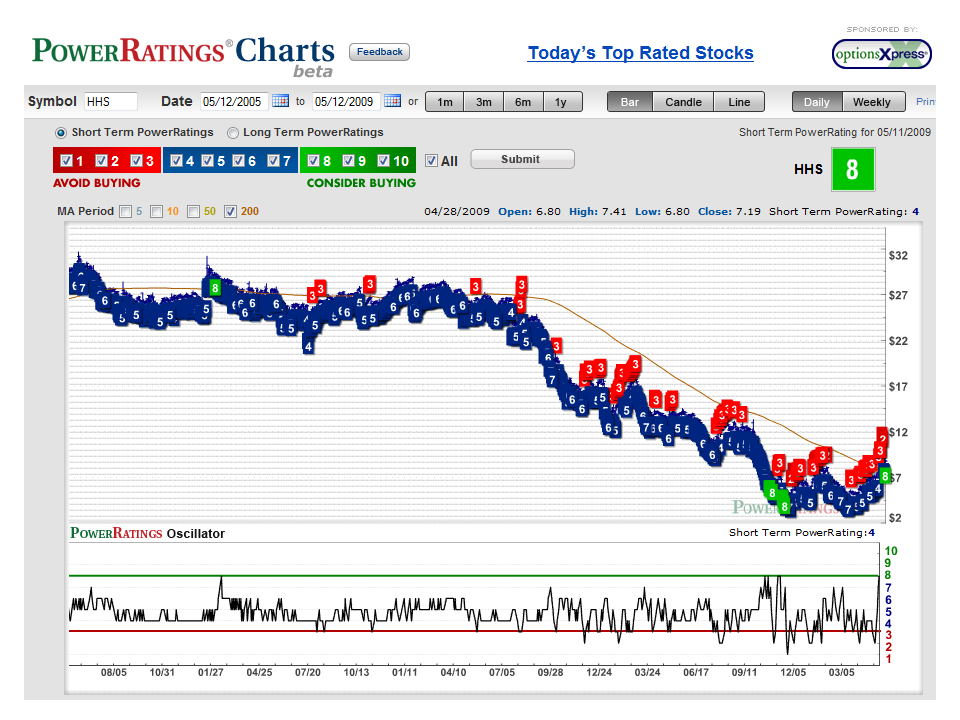
Harte Hanks' stock, May 2005 to May 2009.

Credit: www.tradingmarkets.com

The Harte Hanks CEO says in a May 5th 2009 press release that,

“There continues to be economic uncertainty that makes it difficult to predict when conditions will improve. While we face challenges, we have a terrific client list and our businesses deliver products, services and marketing solutions that are even more necessary in this environment.”

If I go along with him, I have to infer that his clients don’t get the HH value proposition. If they got it, they’d buy. But who could be better at conveying value through marketing communications than a Harte Hanks? There must be something else going on.

Truth be told, Harte Hanks has, itself, moved into the website building business (see paragraphs under “Selected Highlights” near the bottom of this release).

Bye bye, list biz?

So yes, colleagues in the list biz, I’d recommend changing your focus. And I don’t take the issue lightly. It’s your career and livelihood we’re discussing.

A September 2008 post here called Is B2B marketing going obsolete? said 

“The marketplace has experienced a significant shift in power. No longer are just vendors hunting prospects. Prospects, now, are experienced marksmen too. So… what now? What does this mean for B2B marketers? Should we change professions? Retool our company’s marketing? Wait and see?”

More recently, ”The State Of Retailing Online 2009: Marketing Report,” the 12th annual study conducted for Shop.org by Forrester Research Inc., showed that 88 percent of retailers surveyed said email is a high priority for the coming year, largely to retain customers.

Notice those last three words. These are emails to people who already have a relationshipwith the retailers. Not to prospects from purchased lists.

In fact, the study said 71 percent of retailers plan to send segmented emails to customers based on stated preferences or purchase data.

Challenges of being in the school of push communications

In What won’t fly in that 2009 marketing plan I suggested that B2B marketers consider skipping traditional marketing techniques in their 2009 marketing plans.

The reason: Purchased lists, whether they involve emailing, snail-mailing or telemarketing, belong to the school of ‘push’ communications.

Core skills of a successful list broker

So where does that leave list brokers? Many have been very, very successful for a long, long time with lists.

I’d venture that the best list brokers are particularly savvy about:

  • Client relationship management
  • Audience segmentation, including
    • Behavioral targeting
    • Psychographics
  • A/B testing 
  • Quantifying ROI

What are some other strengths of a well-trained list broker? How can they apply their skills to newer marketing methods?

Resources — please add

I’ll start us off with a suggested resource — an article in the Hubspot blog. Please add your ideas.

  1. Ten Tips for Marketing Job-Seekers in the Class of 2009

Comments

Rebekah – thank you for your reply and questions. The question about HH is a great one and lists or market issues are among my personal favorites (having been with a direct mail marketing firm that mailed over 100,000,000 catalogs per year from 1985 – 89). I believe that a good list (a targeted market with accurate contact data and “demographics”) can represent 60% of the potential success or failure of a marketing campaign (with creative and offer making up equal amounts of the balance). The problem, as I see it, is that list quality is expensive to maintain and data aggregators are faced with a price elasticity curve that declines rapidly (modest increases in price substantially decrease volume). So, these firms (including HH) have to control costs to make money – meaning that they make trade-offs regarding quality and price. So, while I believe that data quality is absolutely essential, I also believe that there is no such thing as a single good list. We coach our clients to build as broad a prospect database as is necessary to target the absolutely best prospects – pulling along other less qualified segments with less expensive marketing methods. This requires a base list (or two)and lots of elbow grease to clean it and keep it clean. 
 
Regarding USPS, some years ago UPS established an electronic delivery system that operated much like the physical delivery except it was all web based (there was a place for a signature, notification to the sender, tracking of movement of the document after it reached the recipient…). As far as I know, this effort was tested and discontinued. 
 
While there may be a business in your thought, I am not sure USPS is the right company to do it. Years ago, AT&T decided it was so successful in its core business that it should sell computers. They found out what Harvard Business School documented later that selling a new solution to your current market (or new market) is not as easy as selling a current solution to the current or new market. They failed. 
 
I was in the direct mail catalog business from 1977 – 1989. I remember, in 1977, reading about how the catalog business was dead because of postage cost and consumer complaints about getting too much mail. I daresay that my home mailbox is as filled with catalogs and direct mail today as it was then (if not more). 
 
I appreciate your nice thoughts and invite you and your readers to see more of our ranting at http://blog.pointclear.com 
 
Thank you!
Posted @ Friday, November 06, 2009 7:19 PM by Dan McDade
Dan – you make a good case that lists won’t go away. Sherpa and other sources show dollars shifting away from traditional marketing though. 
Re paperless office — I’m in one as I type. But it’s still pretty rare — I agree. 
You’re clearly experienced in the sector… so, question: in your view how could Harte Hanks do a better job communicating to businesses that they should be investing in quality data/lists? Remeber the chart in my post shows their customer base is scaling back on those investments… how should HH make the case about social media etc complimenting vs supplanting traditional marketing? They don’t seem to be getting it across, if there is a strong business case there. 
One other question… what do you think about the future of USPS? Could that uber-traditional marketing institution co-exist or adapt to or leverage or ? to in a digital world? 
Thanks again for your comments — folks like you making blogging worthwhile.
Posted @ Friday, November 06, 2009 7:19 PM by Rebekah Donaldson
Talk about lists, cold calling and television being dead always remind me of the famous quote: “rumors of my death have been greatly exaggerated”! I remember that it was once said that paper was dead and that we would be a paperless society. I remember reading about when a great unsinkable ship sailed and, well, sunk. Ten plus years ago sales managers were going to have their lives simplified with sales force automation (which gave way to customer relationship management). Is a sales manager’s life simpler today because of SFA or CRM? Not by a mile. Marketing Automation, the new Holy Grail, treats prospects as though they were the human equivalent of a pin ball – gaining the attention of a supplier only when they hit the right bumpers… Will it fulfill its promises, or will it be one more tool that individuals hide behind rather than rolling up their sleeves and doing the detailed, mind-breaking work that goes into to real marketing? 
 
No, the list business is not dead. While social and other electronic media has an increasingly important role in the marketing mix today, defining, refining, capturing and nurturing a core market will always be required as will the lists that support getting that done.
Posted @ Friday, November 06, 2009 7:20 PM by Dan McDade
In my humble opinion, and based on my limited research/experience, using an inbound-only approach works best for small companies that have little to no marketshare or those that work in industries that are not yet proficient in online marketing and demand generation. 
 
For most growth oriented and/or medium-to-large organizations, the problem with inbound leads is that there’s simply not enough of them. Or as @marcblumer wrote to me on Twitter: “Good take on list biz. Inbound IS growing. But B2B marketers will always have need for >leads “now” and tactics to land them.” 
 
As for list industries foray into SEO, they do not have the ability to capture behavioral data like DoubleClick/Google. I think that they were simply looking for a viable, albeit unrelated, service that they could offer to their clients. 
 
Thanks Rebekah for the nod and twitter recco.
Posted @ Friday, November 06, 2009 7:20 PM by Scott Hardigree
Scott your comment is really insightful. There are many important points packed into that last part, in particular: 
 
"...top-level suppliers have not yet been forced to change their models… which I suppose it testament to the list value proposition..." 
 
There is definitely a healthy debate among inbound marketers regarding whether inbound alone is enough; or inbound should be paired with 'traditional' tactics like direct mail, call outs, and trying to drive event attendance. Where do you stand on that? 
 
Also I'm intrigued by your mention of data scrapers offering SEO-related products -- tell more about that?! Are they selling intelligence regarding search habits, like a DoubleClick? Or helping build personas for clients? Or something else? Interesting. 
 
Peeps, Follow ‘IndieScott’ on Twitter.
Posted @ Friday, November 06, 2009 7:21 PM by Rebekah Donaldson
It’s true that may list brokers, managers, and compilers (myself included) are struggling with waning revenue/demand and how to best transition their expertise, offerings, and clients in this rapidly evolving marketplace. However, this also holds true for traditional branding-based ad/marketing firms and countless other old school marketing suppliers. 
 
Specific to the list industry, and for sometime now, most of the largest and most repuatuble companies have been experimenting with new offerings such as SEO (Yes SEO, believe it or not) yet nothing, outside of the addition of mobile data, has stuck. Perhaps it’s because (as you stated) the industry is still a billion dollar one and those top-level suppliers have not yet been forced to change their models…which I suppose it testament to the list value proposition or the marketer’s need to grow revenue beyond what inbound efforts can provide.
Posted @ Friday, November 06, 2009 7:22 PM by Scott Hardigree
Ira thanks for writing in! Yes I’m psychic… when I can stack the audience that is :-) ) 
 
These resources are GREAT! 
 
Please write in when you can about applying the resources at these sites to your own situation…
Posted @ Friday, November 06, 2009 7:22 PM by Rebekah Donaldson
Rebekah, 
 
Thanks for your candid article. I have had some of the exact concerns stated here, almost like you were reading my mind... 
 
I would like to contribute a few resources I have found: 
 
The LinkedIn Blog » Blog Archive What recruiters look for in a LinkedIn profile: 8 tips « http://bit.ly/L2cwq 
 
Search for a new profession with Path101 Alpha- The Resume Genome Project « AltSearchEngines - http://tinyurl.com/oebmbe 
 
5 Things You Should Know to Power Your Job Search- The Extended Application of Search Marketing- http://bit.ly/4d18m 
 
FREE ebook: http://www.socmedia101.com/ebooks/ 
 
Help Me to Help You - “You can have everything in life you want, if you will just help enough other people get what they want.” 
 
I'm looking for new projects & opportunities as a transition from list broker/direct marketing consultant to inbound marketer. Help a would be inbound marketer realize his dreams. Find me on Twitter: http://twitter.com/icdlist 
 
Thanks again for all your thoughts Rebekah, you've helped point me in a direction, now it's up to me to make it the right direction. 
 
Ira J. Cohen
Posted @ Friday, November 06, 2009 7:23 PM by Ira J. Cohen
Comments have been closed for this article.